
CASE 013
:
THE CASE OF THE MIDNIGHT GHOST
Guests at Ashworth House have been seeing the same pale figure cross the upper corridor shortly after midnight. The security camera recorded it. A door handle moved by itself. The building has been standing for 140 years without a single ghost report — until six weeks ago. Something changed. The question is what.

CASE BRIEFING
Ashworth House has stood on the edge of the village of Cresthollow since 1847.
For 140 years it was a private family home. In 1987 Margaret Calloway — who had grown up in the house — converted it into a small historic inn following the death of her parents. She kept the original Victorian features intact — the cast iron fireplaces, the wide oak staircase, the original sash windows with their slightly imperfect Victorian glass, the gilt-framed mirrors in the upstairs corridor.
Thirty-five years of operation. Thousands of guests. Not a single unusual report.
Until six weeks ago.
It began with a couple in Room 6 — a retired teacher and her husband from Edinburgh. They mentioned it almost apologetically at checkout. They had both woken around midnight and seen something in the corridor through their open door. A pale shape. Moving slowly. Gone before they could be certain of what they had seen. They were embarrassed to mention it.
Margaret thanked them and thought nothing of it.
Two weeks later a family of four checked out of Rooms 7 and 8. The father — a structural engineer from Bristol — asked to speak to Margaret privately before leaving. He described seeing a pale translucent figure crossing the corridor outside his room at approximately 12:45 AM. He had watched it for three or four seconds before it disappeared. He was not embarrassed. He was certain of what he had seen.
"I don't believe in ghosts," he told Margaret. "But I saw something."
The following week a solo traveller — a retired police officer from Manchester — reported slow deliberate footsteps in the corridor outside Room 7 at approximately 12:30 AM. She got up and opened her door. The corridor was empty. She stood and listened for five minutes. The footsteps did not return.
Margaret reviewed the security camera covering the upper corridor. She found nothing on the nights the first two guests had reported the figure.
Then on a Thursday night — at 12:47 AM — the camera captured something.
A pale shape. Moving along the corridor from the direction of Room 7 toward the top of the stairs. Present for approximately eleven seconds. Gone.
Margaret watched the footage four times. Then she called Dr. James Okoro — a physicist at the nearby university who had consulted on building restoration projects — and asked him to come and look.
"I have never had a report like this in 35 years," she told him. "I need to understand what is happening to my building."
Dr. Okoro arrived the following morning with measuring equipment, temperature sensors, audio recording devices, and a forensic lighting kit.
He was joined by Detective Constable Priya Venn — whose interest had been triggered by the retired police officer's report — and Dr. Sarah Mensah, an acoustic engineer from the university.
Before the investigation team had been in the building for two hours they had identified four distinct phenomena that required explanation.
A pale translucent figure visible on camera and to multiple independent witnesses.
Slow footsteps heard in an empty corridor at approximately 12:30 AM.
A localised cold zone in the corridor between Room 7 and the stairs.
A door handle on Room 8 that moved by itself while the guest inside was awake and watching.
Four phenomena. Four independent witnesses. One building that had stood for 140 years without incident.
Dr. Okoro stood in the upper corridor on the first morning of the investigation and looked at the gilt-framed mirror at the far end — the original Victorian glass slightly darkened with age.
"Everything has an explanation," he said. "The interesting question is whether this building has four separate ones."
Your investigation begins now.
Ashworth House has not changed in 140 years. Something changed six weeks ago — and the investigation team has four distinct phenomena to explain before they can tell Margaret Calloway what is happening in her building.
Examine all five Evidence Files. The witness accounts, the camera footage, the acoustic analysis, the temperature data, and the optical reconstruction all have something to say.
Not everything that looks supernatural is. But the explanation for what is happening at Ashworth House is stranger than most people would expect — and the science behind it has been hiding in plain sight for over a century.
What is the midnight ghost of Ashworth House?
Instructions:
Play solo or with a team of up to 5 investigators. Examine the five Evidence Files together, or divide them among your team and have each investigator analyze different clues. Share what you discover, compare theories, and decide which evidence matters most.
When you've examined all the evidence, work individually or as a team to reach your final verdict—then reveal the solution to see if you cracked the case.
EVIDENCE FILES
EVIDENCE FILE 01 +
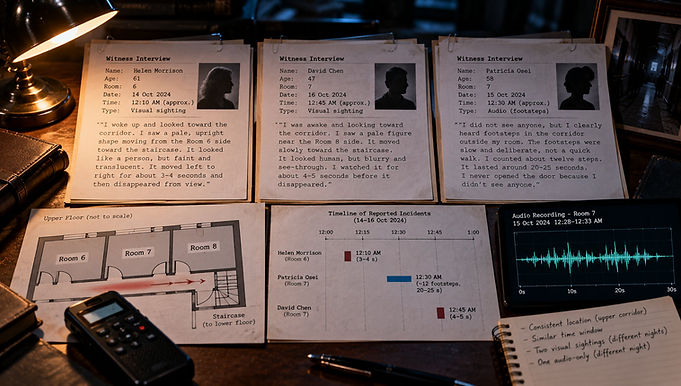
EVIDENCE FILE 01 — WITNESS ACCOUNTS
Case Reference: ACH-2024-1103
Evidence Item: EV-01 — Independent witness interviews
Prepared By: DC Priya Venn, Cresthollow Police
Date: Monday — 10:00 AM
BACKGROUND
DC Venn conducted separate recorded interviews with three guests who had reported unusual experiences at Ashworth House over the previous six weeks. The interviews were conducted independently — no witness was aware of the other accounts before giving their own.
WITNESS 1 — HELEN MORRISON, 61 — Room 6
Date of experience: Six weeks ago — approximately 12:10 AM
"I woke up and the corridor was visible through our open door. There was a shape — pale, upright, moving slowly from left to right. I thought it was another guest at first. But it was too pale. Too — thin, I suppose. It moved at a steady pace and then it was gone. I watched for another minute but nothing came back. My husband saw it too. We decided not to mention it but then at checkout it came out."
Duration of sighting: approximately 3 to 4 seconds
Direction of movement: left to right — toward the staircase
Sound associated with figure: none reported
Emotional response: mild unease — not significant distress
WITNESS 2 — DAVID CHEN, 47 — Room 7
Date of experience: Four weeks ago — approximately 12:45 AM
"I was awake — I'd got up for water. I saw it clearly. A pale figure — translucent, I'd say. You could see the corridor wall through it slightly. Moving at a consistent speed. No footsteps. No sound at all. It crossed from the direction of Room 8 toward the stairs and simply wasn't there anymore. I'm a structural engineer. I don't say things I'm not certain of."
Duration of sighting: approximately 4 to 5 seconds
Direction of movement: from Room 8 side toward staircase
Sound associated with figure: none reported
Emotional response: calm — described as curious rather than frightened
WITNESS 3 — PATRICIA OSEI, 58 — Room 7
Date of experience: Two weeks ago — approximately 12:30 AM
"I didn't see anything. What I heard was footsteps. Slow — deliberate — like someone walking carefully so as not to wake people. I counted approximately twelve steps. Then nothing. I opened my door immediately. The corridor was completely empty. I stood there for five minutes. Nobody came. Nobody went. The footsteps simply stopped."
Duration of experience: approximately 20 to 25 seconds
Visual component: none
Sound: slow deliberate footsteps — estimated 12 steps — consistent pace
Emotional response: significant — described as deeply unsettling
KEY CONSISTENCIES
DC Venn noted the following consistencies across the three independent accounts:
All three experiences occurred between 12:10 AM and 12:50 AM.
All three located the phenomenon in the same section of the upper corridor — between Room 7 and the top of the staircase.
Witnesses 1 and 2 described a pale translucent figure moving at a consistent pace with no associated sound.
Witness 3 reported footsteps with no associated visual figure.
No witness had spoken to any other witness before giving their account.
ONE NOTABLE DETAIL
DC Venn asked each witness when they had arrived at Ashworth House and whether they had been told anything about the building before their stay.
Helen Morrison: arrived without prior knowledge — booked through an online travel platform.
David Chen: arrived without prior knowledge — booked directly with the inn.
Patricia Osei: had read one online review mentioning "atmospheric Victorian character" — no mention of any unusual occurrences.
None of the three witnesses had any prior knowledge of other reports before their own experience.
YOUR TASK
Three independent witnesses. No prior contact with each other. No prior knowledge of other reports. All experiencing phenomena in the same location during the same narrow time window.
What does the consistency of these accounts tell you — and what does it leave open?
Consider what three independent witnesses agreeing on location and timing establishes — and what it cannot establish.
Consistency across independent witnesses makes a purely individual explanation less likely, but does not establish what caused the experiences.
Research the psychology of witness testimony and what conditions produce consistent accounts across unrelated people. Then consider — what natural phenomenon, present in that corridor between midnight and 1 AM, could produce both a visual experience and an auditory experience that witnesses would describe in exactly these terms?
Evidence File 02 will examine what the security camera actually recorded at 12:47 AM.
EVIDENCE FILE 02 +

EVIDENCE FILE 02 — SECURITY CAMERA ANALYSIS
Case Reference: ACH-2024-1103
Evidence Item: EV-02 — Upper corridor camera footage review
Prepared By: Dr. James Okoro, Physics Department, Cresthollow University
Date: Monday — 2:00 PM
BACKGROUND
A single security camera covers the upper corridor at Ashworth House — mounted at ceiling level at the staircase end, angled to cover the full length of the corridor from the stairs to Room 9. The camera records continuously in standard definition at 25 frames per second.
Margaret Calloway identified one recording of significance — Thursday night at 12:47 AM — in which a pale shape is visible moving along the corridor. Dr. Okoro conducted a detailed frame-by-frame analysis of the footage.
WHAT THE FOOTAGE SHOWS
The pale shape is present in the footage for eleven seconds — from 12:47:03 AM to 12:47:14 AM.
It moves from the Room 8 end of the corridor toward the staircase at a consistent speed — covering approximately 8 metres in eleven seconds.
At first viewing the shape is consistent with a person moving along the corridor. It is upright, approximately human height, and pale against the darker corridor background.
FRAME BY FRAME ANALYSIS — THREE ANOMALIES
Dr. Okoro conducted a detailed examination of individual frames and identified three characteristics inconsistent with a solid physical object.
Anomaly 1 — No shadow
Every solid object in the corridor casts a faint shadow from the emergency lighting strip running along the ceiling. The fire extinguisher on the wall casts a shadow. The corridor door frames cast shadows. The picture frames cast shadows.
The pale shape casts no shadow.
A person or solid object in that corridor under those lighting conditions would cast a measurable shadow. The absence of any shadow is inconsistent with a solid physical presence.
Anomaly 2 — Partial transparency
In 14 individual frames Dr. Okoro identified sections of the corridor wall — specifically the wallpaper pattern — visible through the pale shape at reduced contrast.
A solid object does not permit light to pass through it. A reflection or projected image does.
Anomaly 3 — Movement pattern
Human walking produces a characteristic vertical oscillation — the body rises slightly with each step and falls between steps. This produces a subtle but measurable up-down rhythm in footage of a walking person.
The pale shape shows no vertical oscillation. Its movement is perfectly horizontal and consistent — gliding rather than walking.
DR. OKORO'S PRELIMINARY ASSESSMENT
"The three anomalies — absent shadow, partial transparency, and absence of walking oscillation — are collectively inconsistent with a solid physical object moving through the corridor. They are consistent with a reflected or projected image of a light source or illuminated object located elsewhere in the building.
In other words — something real is producing this image. But the thing producing it is not in the corridor."
YOUR TASK
The camera recorded something real. Three anomalies in that recording suggest it was not a solid object in the corridor.
Research the difference between a reflection and a solid object in optical terms — and what conditions are required to produce a pale translucent moving image in a location where the source object is not present.
Consider the geometry of Ashworth House. The camera is at the staircase end of the corridor. The corridor has doors, mirrors, and windows. The staircase connects to the ground floor.
If the pale shape is a reflected image — what was being reflected, where was the source, and what surface produced the reflection visible in the corridor?
That question is the heart of this investigation. Evidence Files 03 and 04 will address the footsteps and the cold zone. Evidence File 05 will reconstruct the optical mechanism that produced the apparition.
But you have enough information now to form a hypothesis. What do you think is creating the pale shape — and where in the building is the real source?
EVIDENCE FILE 03 +

EVIDENCE FILE 03 — ACOUSTIC ANALYSIS
Case Reference: ACH-2024-1103
Evidence Item: EV-03 — Footstep sound investigation
Prepared By: Dr. Sarah Mensah, Acoustic Engineer, Cresthollow University
Date: Tuesday — 11:00 AM
BACKGROUND
Witness 3 — Patricia Osei — reported slow deliberate footsteps in the upper corridor at approximately 12:30 AM. No visual figure was associated with the sound. The corridor was empty when she opened her door.
Dr. Mensah installed calibrated audio recording equipment in the upper corridor and in three other locations throughout the building — the ground floor hallway, the basement plant room, and inside the wall cavity adjacent to the corridor. Recordings ran continuously for three nights.
RECORDINGS — NIGHTS ONE AND TWO
No unusual sounds were recorded on Night One.
On Night Two — at 12:34 AM — the corridor microphone detected a repeating sound pattern lasting approximately 22 minutes.
The sound was characterised as:
Low frequency — approximately 40 to 60 Hz
Rhythmic — repeating at intervals of approximately 0.9 seconds
Origin: appearing to come from within the corridor wall structure rather than from the floor surface
0.9 seconds between sounds — for reference — is consistent with the pace of a slow deliberate human walk.
SOURCE IDENTIFICATION
Dr. Mensah compared the corridor recording against the simultaneous recordings from the other three microphones.
The plant room microphone — located in the basement directly below the corridor — showed a strong correlation with the corridor sound. The same rhythmic pattern appeared in the plant room recording approximately 0.3 seconds earlier than in the corridor recording.
This delay is consistent with sound travelling upward through the building structure from the basement to the upper corridor at the known acoustic propagation speed of timber frame construction.
The sound originated in the basement plant room — not in the corridor.
THE SOURCE — IDENTIFIED
Dr. Mensah examined the plant room and identified the source.
Ashworth House is heated by a Victorian cast iron radiator system — the original pipework installed in the 1890s, maintained and extended but never fully replaced.
The heating system operates on a timer — running from 6:00 PM to 12:20 AM each night, when it cycles down automatically.
As the cast iron pipes cool after 12:20 AM — contracting as the metal loses heat — they produce a series of low frequency knocking and creaking sounds. The specific geometry of the pipework in the basement plant room — a long straight run of 40-millimetre cast iron pipe with four elbow joints — produces sounds at intervals of approximately 0.9 seconds as each section cools sequentially.
The sound travels upward through the building's original Victorian timber frame — which acts as a resonance chamber — and emerges most clearly in the upper corridor where the structural members are oldest and least damped.
Heard from inside Room 7 with the door closed — the sound arrives through the wall structure, slightly muffled, at a rhythm that closely matches the pace of slow deliberate footsteps.
WHY NIGHT ONE PRODUCED NOTHING
Dr. Mensah noted that Night One recordings were taken on a mild evening — ambient temperature 14 degrees Celsius. Night Two was significantly colder — ambient temperature 4 degrees Celsius.
On colder nights the cast iron pipes cool faster after the heating system cycles down — producing more pronounced contraction sounds at the same rhythmic interval.
Patricia Osei's experience occurred on one of the coldest nights of the investigation period.
YOUR TASK
The acoustic analysis has identified the footsteps as thermal contraction sounds produced by Victorian cast iron heating pipes cooling after midnight — travelling through the building's timber frame and emerging in the upper corridor at a rhythm indistinguishable from slow human footsteps.
Research how sound travels through building structures and why cast iron pipes produce noise when cooling. Consider why the sound emerges most clearly in the upper corridor rather than elsewhere in the building — and what the 0.9-second interval tells you about why a listener would interpret it as footsteps rather than a mechanical sound.
Notice also that the heating system cycles down at 12:20 AM every night.
Patricia Osei heard footsteps at 12:30 AM. David Chen saw the figure at 12:45 AM. Helen Morrison saw the figure at 12:10 AM.
Does the heating system timing tell you anything about the relationship between the footsteps and the figure — or are they independent phenomena?
EVIDENCE FILE 04 +

EVIDENCE FILE 04 — TEMPERATURE ANALYSIS AND DOOR INVESTIGATION
Case Reference: ACH-2024-1103
Evidence Item: EV-04 — Thermal mapping and pressure differential analysis
Prepared By: Dr. James Okoro, Physics Department, Cresthollow University
Date: Tuesday — 4:00 PM
BACKGROUND
Two unexplained physical phenomena remained after the camera and acoustic analyses — a cold zone reported by multiple witnesses in the corridor between Room 7 and the staircase, and the movement of the Room 8 door observed by a guest while the corridor was empty.
Dr. Okoro installed calibrated temperature sensors at six points along the upper corridor and conducted a pressure differential survey of the building over two nights.
PART ONE — THE COLD ZONE
Temperature mapping results:
Sensors were positioned at floor level, mid-height, and ceiling level at three points along the corridor — outside Room 7, at the midpoint between Room 7 and the stairs, and at the top of the stairs.
Over two nights of continuous recording a consistent temperature pattern emerged.
The section of corridor between Room 7 and the staircase — specifically the 1.8-metre stretch of corridor adjacent to the wall between Rooms 7 and 8 — recorded temperatures consistently 3.2 to 4.7 degrees Celsius lower than the rest of the corridor.
The cold zone was present throughout the night but most pronounced between midnight and 3 AM.
It was not present at floor level — only at mid-height and ceiling level — indicating the cold air was descending rather than rising from the floor.
Investigation of the wall:
Dr. Okoro requested the building's original Victorian architectural drawings from the local records office.
The drawings confirmed what a careful examination of the wall had suggested — a sealed Victorian chimney flue runs inside the wall between Rooms 7 and 8, connecting to a chimney stack on the roof that was capped with a concrete cap in 1987 when the building was converted.
The flue — approximately 30 centimetres square in cross-section — runs from the capped stack down through the wall and connecting to what was originally the fireplace in Room 7, now blocked and plastered over.
A capped chimney flue is not airtight. Cold night air enters around the concrete cap, descends through the flue, and seeps into the wall cavity through gaps in the original Victorian brickwork.
The cold zone is not supernatural. It is a column of cold air descending through a 140-year-old chimney that has been capped but not sealed.
PART TWO — THE DOOR MOVEMENT
The guest in Room 8 — Robert Hadley, a retired solicitor — reported waking at approximately 12:50 AM to hear something outside his door. He lay still and watched the door. It moved — shifting slightly inward in its frame with a faint rattling sound — before settling back. The door did not open. The latch held.
But the door itself moved perceptibly as though someone on the other side had pushed it gently and then stopped. He waited thirty seconds then opened the door himself. The corridor was empty.
Pressure differential analysis:
Dr. Okoro measured air pressure at multiple points in the building throughout the night — including inside Room 8, in the corridor outside, and at the corridor end of the chimney flue cavity.
The analysis identified a specific sequence of events.
At approximately 12:45 AM on nights when Room 8's window is open — as it was on the night of Mr. Hadley's experience, confirmed by his account — a pressure differential develops between Room 8 and the corridor.
The mechanism:
The cold air column descending through the chimney flue creates a slight negative pressure in the corridor wall cavity adjacent to Room 8. When Room 8's window is open warm air flows from the room toward the corridor — drawn by the pressure differential — through the small gap beneath the room door.
This airflow acts on the door surface as a whole — a large surface area relative to the force required. Dr. Okoro confirmed that the Room 8 door sits slightly loose in its Victorian frame with approximately 3 millimetres of play in the fitting — entirely typical of a door frame that has settled and shifted over 140 years.
The pressure differential is sufficient to push the door inward against the latch — moving it 2 to 3 millimetres within its frame and producing a faint rattling sound — before the pressure equalises and the door returns to its resting position.
No person pushed the door.
The cold chimney flue and the open window did it together.
YOUR TASK
The temperature analysis has identified a sealed Victorian chimney flue as the source of the cold zone — cold air descending through an imperfectly capped stack and seeping into the corridor wall.
The door movement has been explained by the pressure differential created by the same chimney flue — drawing air from Room 8 when the window is open and acting on the full surface of a slightly loose Victorian door with sufficient force to move it against its latch.
Research how chimney flues create pressure differentials and why capping rather than fully sealing a chimney can create cold spots in a building. Consider what the 140-year history of Ashworth House tells you about why this has only become a problem in the last six weeks.
That last question is important. The chimney has been capped since 1987. The cold zone and the door movement have only been reported for six weeks.
What might have changed six weeks ago — inside the building or outside it — to make a 37-year-old chimney cap suddenly produce these effects? And does the timing of the cold zone connect to anything else you have found in the previous evidence files?
EVIDENCE FILE 05 +

EVIDENCE FILE 05 — OPTICAL RECONSTRUCTION AND FULL EXPLANATION
Case Reference: ACH-2024-1103
Evidence Item: EV-05 — Light projection analysis and six-week trigger identification
Prepared By: Dr. James Okoro, Physics Department, Cresthollow University
Date: Wednesday — 9:00 AM
BACKGROUND
Four phenomena have now been explained independently — the pale figure on camera, the footsteps, the cold zone, and the door movement. This file addresses two remaining questions.
First — what is the precise optical mechanism producing the pale figure, and where is the real source?
Second — why did all four phenomena begin six weeks ago after 37 years of no reports?
PART ONE — THE OPTICAL MECHANISM
Dr. Okoro returned to the three anomalies identified in Evidence File 02.
No shadow. Partial transparency. No walking oscillation.
These three properties together point toward one specific optical phenomenon — a moving light projection rather than a solid object.
LIGHT PROJECTION — THE SCIENCE
When a moving light source outside a building illuminates an interior surface through a series of windows and glazed doors — the moving light pattern travels through the building in straight lines and projects onto interior walls and ceilings.
The projected shape is not a solid object. It is light falling on a surface.
This explains all three camera anomalies precisely:
A light projection casts no shadow — because it is itself light, not an object blocking light.
A light projection appears partially transparent — because the surface it falls on remains visible through it.
A light projection moves without walking oscillation — because the movement of a distant light source produces smooth lateral movement on an interior surface rather than the vertical oscillation of a walking person.
MAPPING THE LIGHT PATH
Dr. Okoro mapped the geometry of Ashworth House to identify how light from outside the building could reach the upper corridor.
The inn's bar occupies the ground floor front room. It has three large original Victorian sash windows facing the car park to the east.
At the base of the staircase — which connects the bar level to the upper corridor — a glazed door with original Victorian glass separates the hallway from the bar. The glass is 4 millimetres thick with minor optical imperfections typical of Victorian manufacture.
The staircase rises from the hallway at an angle that places the upper corridor directly in line with light travelling upward from the bar windows through the glazed door.
On nights when the car park is active — vehicles arriving and departing, people walking to their cars under the car park lighting — moving light enters the bar windows, passes through the glazed hallway door, travels up the staircase, and reaches the upper corridor wall opposite the staircase top.
From the position of a guest in Room 7 looking through an open door — a moving pale shape on the corridor wall, produced by car park activity below, appears as a translucent figure moving along the corridor.
THE CONFIRMATION
On Wednesday evening Dr. Okoro asked DC Venn to walk slowly through the car park while he observed the upper corridor with the bar lights off and the car park lighting on.
At 11:52 PM — as DC Venn moved from the car park entrance toward her vehicle — a pale moving shape appeared on the upper corridor wall opposite the staircase top.
It moved from the Room 8 end of the corridor toward the staircase at a consistent pace.
It lasted approximately eight seconds.
It cast no shadow.
It appeared partially transparent — the corridor wallpaper was visible through it.
It moved without walking oscillation.
Dr. Okoro then asked a second person to drive slowly through the car park with headlights on.
As the headlights swept across the bar windows the pale shape in the upper corridor moved more rapidly — sweeping across the wall in approximately three seconds before disappearing as the car turned away.
The security camera footage from the Thursday night recording — reviewed again with this mechanism in mind — shows the pale shape moving at a speed and smoothness consistent with a person walking through the car park below rather than a person walking along the corridor.
PART TWO — THE SIX-WEEK TRIGGER
All four phenomena began six weeks ago. Ashworth House had operated for 37 years without a single report.
Dr. Okoro identified one change that occurred six weeks ago — confirmed by Margaret Calloway.
Six weeks ago the inn's bar extended its Thursday night opening hours from 10:30 PM to 1:00 AM — to accommodate a local quiz night that had recently moved to Ashworth House from a nearby pub that had closed.
Before six weeks ago the car park was empty and dark by 10:30 PM on Thursday nights. The light projection mechanism had no moving light source to work with. The corridor wall was dark and still.
Six weeks ago the quiz night began. The car park filled with vehicles. People walked to their cars after midnight. Headlights swept across the bar windows as vehicles departed. The light projection mechanism had a moving light source for the first time.
The figure appeared.
The footsteps — produced by the cast iron pipes cooling after midnight — had always been present on cold nights. But before six weeks ago there were no guests in Rooms 7 and 8 on Thursday nights — the inn had not previously made those rooms available while the bar hosted events. Six weeks ago that policy changed.
The first guests in Room 7 on a cold Thursday night heard the pipes for the first time.
The chimney flue cold zone and door movement had also always been present on cold nights — but no previous guest had slept in Room 8 with the window open on a cold Thursday night and been awake at 12:50 AM to experience them.
All four phenomena existed before six weeks ago. None had ever combined with the right witness at the right time in the right room on the right night.
Six weeks ago — the quiz night, the extended bar hours, and the decision to make rooms available on Thursday nights — created the conditions for all four to be experienced simultaneously for the first time in the building's 140-year history.
Ashworth House had not changed.
The Thursday night had.
YOUR TASK
You now have all five Evidence Files.
The pale figure is light from the car park projected through the bar windows and glazed stairwell door onto the upper corridor wall — created by quiz night guests walking to their cars and headlights sweeping through the windows after midnight. The footsteps are cast iron pipes cooling after the heating system cycles down at 12:20 AM. The cold zone is a capped Victorian chimney flue drawing cold air from the roof into the corridor wall. The door movement is a pressure differential created by the same flue acting on a slightly loose Victorian door frame when Room 8's window is open.
Four phenomena. Four independent scientific explanations. One trigger — a quiz night that moved pubs six weeks ago.
Using evidence from all five files — what is the midnight ghost of Ashworth House? Build your case explaining each phenomenon and its cause. Then answer the question that connects all four: what single event six weeks ago made a 140-year-old building suddenly appear haunted?
Margaret Calloway has been running this inn for 35 years. She deserves an explanation she can give her guests.
What do you tell her?
HAVE YOU SOLVED THE CASE?
Review the evidence and decide what you think happened. If you're investigating with others, discuss your findings and agree on your final verdict before revealing the answer.
Once your team has reached a conclusion, reveal the answer.